en
In early February 2026, a new word began circulating on trading floors: the “SaaSpocalypse.”
It was reportedly coined by a Jefferies trader, and it named a fear that had suddenly turned into price action. If AI agents could do the work that employees performed inside business software, the logic went, then an industry that had billed companies by the seat for two decades was in trouble.
Several analyses tied the trigger to the launch of agent tools by Anthropic, including Claude Cowork.
Estimates of the damage vary widely, from roughly $285 billion erased in 48 hours to close to $2 trillion in cumulative losses since January, depending on who is counting and what they include.
Eight months on, the mood has changed. Salesforce reported a record second quarter on 26 August, and its shares jumped.
The sector’s main exchange-traded fund moved back into positive territory for the year. Dreamforce, held in San Francisco from 15 to 17 September, then gave the industry something it had lacked since February: a story about what comes next.
This article argues that the panic is genuinely over, and that declaring the industry saved would misread why. Markets have stopped pricing the extinction of software as a service. They have not yet decided who will capture the value of the agentic era. That question, about interfaces, data and pricing, is where the real debate now lies.
The rebound is real, bit has been neither smooth nor complete.
.png)
By mid-April, the iShares software ETF (IGV) had lost about a third of its value from its September 2025 peak. It then posted a gain of roughly 14% in a single week, its best in about twenty-five year.
By late May, the fund stood more than 25% above its April lows, a technical bull market, yet Salesforce shares were still down about 32% for the year while the Nasdaq 100 was up 18%. In June, Salesforce touched a new three-year low. The recovery had, in other words, already been announced once and then tested.
The second attempt rests on firmer ground. On 26 August, Salesforce reported that annual recurring revenue from Agentforce and Data 360 had reached nearly $3.9 billion, up more than 210% in a year.
The company said it had delivered 7.0 billion “agentic work units,” 3.2 billion of them in the quarter. Remaining performance obligations grew 14% at constant currency, and full-year revenue guidance rose to between $46.1 billion and $46.4 billion, an increase of 11% to 12% . The shares jumped about 14% after hours and, within days, were close to their January level .
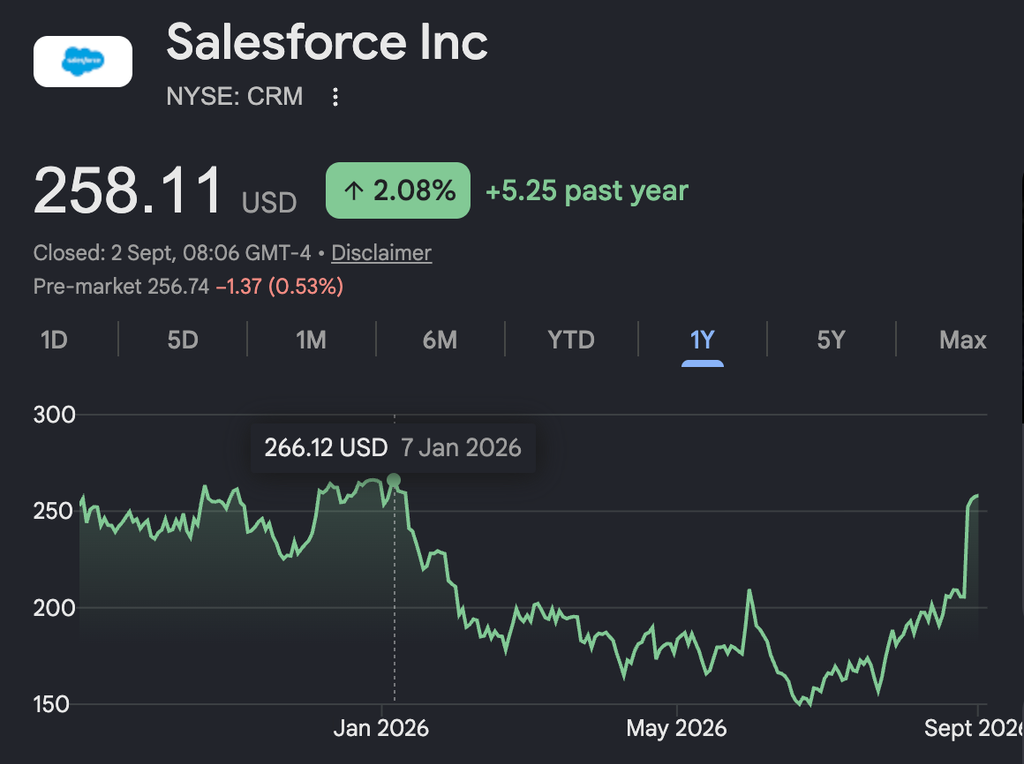
By 31 August the software ETF had turned positive for the year, helped by Salesforce’s largest new annual bookings in four years.
Three caveats keep the picture honest.
First, Salesforce widened the definition of Agentforce revenue this quarter to include its AI offerings, Slackbot and Headless 360, so the headline growth is not a like-for-like comparison.
Second, set against the annual revenue forecast, Agentforce represents roughly 3% of sales, and Agentforce plus Data 360 less than 10% (our calculation from the published figures).
Third, some analysts attribute part of the August rally to investors repositioning into undervalued stocks rather than to a change in fundamentals.
The research houses are similarly split between reassurance and warning.
Gartner estimated in July that up to $234 billion of enterprise application spending is exposed to what it calls “agentic arbitrage” through 2030, about 20% of application SaaS spending, while insisting that the industry will be reshaped rather than destroyed. Deloitte considers that agents could eventually replace some enterprise applications, but not in 2026.
And adoption lags ambition: McKinsey finds that 62% of organizations are experimenting with agents but only 39% report an earnings impact, while Gartner expects more than 40% of agentic projects to be cancelled by the end of 2027.
The selloff had its roots in an economic fact rather than a technical one.
AI agents, which can carry out multi-step tasks without a human clicking through screens, threaten to break that link between headcount and spending.
In late January and early February, the release of new agent tools by Anthropic, notably Claude Cowork plugins, crystallized that worry, and software stocks fell sharply over the following trading sessions.
By March 31, the SEG SaaS Index, which tracks more than 120 listed software companies, was down 25.7% for the year. Not everyone accepted the diagnosis. Amazon Web Services’ chief executive called the panic overblown in mid-February and pointed out that inflation and interest rates were also weighing on software valuations (Cirra).
Salesforce’s own leadership has dismissed the narrative outright (Salesforce Ben). But the selloff was indiscriminate: it hit companies whose products are easy to replace and companies whose value lies in data and processes alike. That is why the later recovery was always going to depend on proof rather than argument.
Salesforce spent the following months building that proof. Over the previous twelve months it had already turned Slackbot into an agentic entry point, opened its platform to third-party interfaces through Headless 360, and launched Agentforce Contact Center. Alongside its August results came Claudeforce, a partnership with the very company whose tools had triggered the scare.
Dreamforce 2026 pulled these threads together in front of roughly 43,000 attendees.
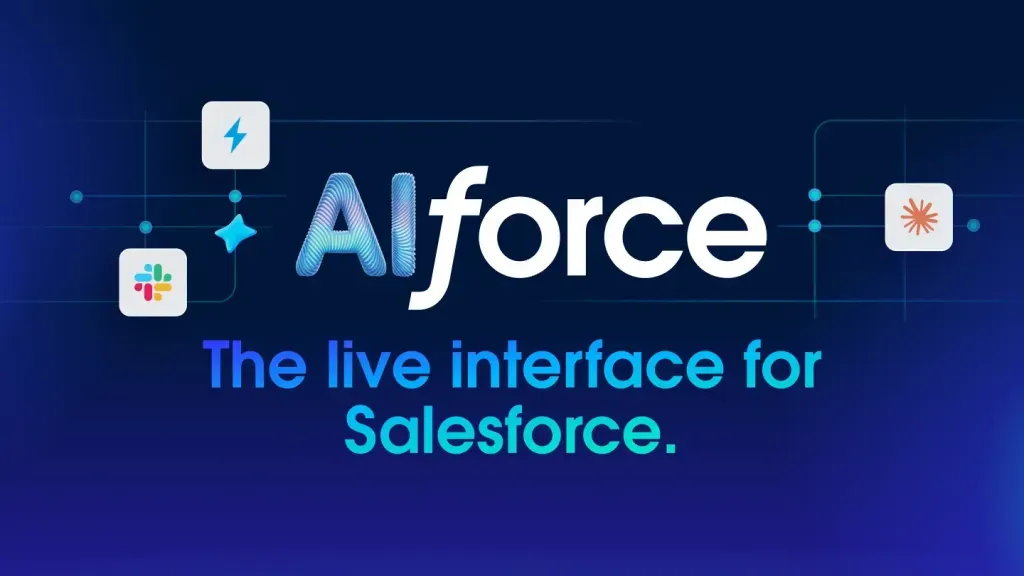
The centerpiece, AIforce, is an interface layer that carries Salesforce’s governed data, workflows and actions into environments such as Slack, Claude and Agentforce Coworker. Salesforce also presented seven job-specific agents, a proprietary CRM reasoning model called Koa built with NVIDIA, and Data 360 as the layer of trusted context on which all of it depends
The company’s stated ambition is a world in which users no longer log in to its applications at all. For an industry accused of being about to lose its interface, it was a striking answer: Salesforce would give the interface away and keep what sits behind it.
The recovery rests on a bet that Dreamforce made explicitly: that the value of enterprise software lives in the data, processes and governance behind the screen, not in the screen itself. The bet may well be right. But it is precisely the claim that remains contested, and it raises three questions that no quarterly result can settle.
The first concerns the interface. If employees increasingly work through Claude or Slack rather than through Salesforce’s own applications, Salesforce risks becoming a system of record that others dress up.
Robert Sösemann of Aquiva has described the new partnerships as an unbundling in disguise, warning that an AI lab could one day help customers move away from Salesforce.
We have an opposite view on the landscape: AI creates most value when it can draw on the structured data and deterministic processes that hundreds of thousands of companies have already codified in Salesforce. A Microsoft executive makes a similar case in Fortune, arguing that SaaS is turning into the operating system on which agents ru.
The second concerns price. Salesforce now sells Agentforce in three ways at once:
- Flex Credits, at about $500 per 100,000 credits or roughly ten cents per agent action
- Conversations at $2 each
- Per-user add-ons from $125 a month
A further step is coming. Agents that connect to the platform will have to register under an “Agentic Identity,” and every successful call they make through MCP or an API will consume Flex Credits, with 30 days’ notice before billing starts. Commentators have noted that customers using outside AI tools could end up paying both their AI provider and Salesforce.
This is the logic Gartner anticipates: by 2030, it expects at least 40% of enterprise SaaS spending to move toward usage-, agent- or outcome-based pricing. Growth in users no longer guarantees growth in revenue.
The third concerns who ends up with the market. Gartner expects the legacy SaaS share to be cannibalized by incumbents or captured by new entrants that offer horizontal agentic platforms across systems. That is a different story from both extinction and survival. It is a story of disaggregation.
The real problem, then, is no longer whether software-as-a-service survives. It is where the margin will sit once the interface becomes interchangeable and the unit of account shifts from the seat to the task.
Is the SaaSpocalypse over? As a panic, yes. Indeed, Record results, partnerships between software vendors and AI labs, and a coherent strategic answer at Dreamforce have together removed the idea that software was about to vanish.
The market has moved from trading a narrative to examining evidence.
As a structural question, no. The industry is being asked to change what it sells, how it charges and where its customers meet it, all at once. The evidence so far shows that the largest players can adapt. It does not yet show who will keep the margin.
Five signals will tell:
The next test will not come from a keynote. It will come from invoices.